

About
Kathi Bond, owner of CryoPlus, Inc. is a member in ASM International in the Akron, Canton, and Cleveland Chapter. She is a member of the Cryogenic Society, Wooster Area Chamber of Commerce, a member of Wooster Noon Lions, a Founding Lifetime Member of ATHENA International and the President of Wayne County Women's Network. Along with her many associations, Kathi received the Woman of Achievement award in 2008 in Wooster, the Woman of Achievement award in 2009 in Akron, "Lion of the Year" award in 2011 and 2022 and is the 2012 ATHENA Award Recipient for Wayne County. CryoPlus Inc. is certified as a Women's Business Enterprise by WBENC (Women's Business Enterprise National Council).
CryoPlus, Inc, Wooster, Ohio marks 30 years of service to the woodworking, stamping, sawmill, tool and die, welding, punching, musical, shooting and racing industries. It has positioned itself as one of the well-recognized cryogenic service providers in the industry. Two decades of experience have transformed CryoPlus from a new venture into a successful company. In twenty five years, CryoPlus, has taken a lead in the cryogenic industry through their commitment to providing superior service, which has attracted many high profile clients.
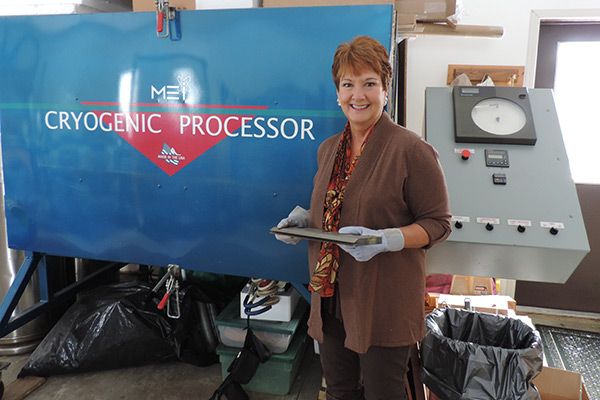
The Process
Cryogenic processing, the deep chilling of tool steel so that the molecular structure of the metal is brought to "cryogenic stillness" in order to improve wear characteristics, is not a new technology. Today's dry process is computer controlled, using a prescribed schedule and maintained at -300F for a particular time before slowly returning the parts to room temperature. The dry process means the material is not exposed to any cryogenic liquids, eliminating the risk of thermal shock. The microprocessor is programmed according to size, weight and configuration of the parts being treated. It controls the flow of the liquid nitrogen into the chamber where the liquid is contained and the boil off vapor is spread throughout the chamber. Prior to the deep cryogenic step, many tool steels require a preconditioning step consisting of a short temper. Once the temperature reaches -300F the cryogenic process enters the "soak phase" which maintains this temperature for a period to allow for transformation on the molecular level. After being subjected to the deep freeze, the materials must be tempered to about +300F. This temperature varies for different materials, and the processing time varies for different material cross sections.
For more detailed information about the cryogenic process read the Thermal Processing magazine article.